Unearth what AI needs to know about your Laravel app.
Scan your app, then generate a Markdown context file with every route, model, and job
cited to its file and line — so Claude Code, Cursor, or Copilot
stop guessing and start citing your actual codebase.
$ php artisan necromancer:scan
Necromancer manifest written to necromancer.json

$ php artisan necromancer:generate
Full context written to NECROMANCER.md
Compact context written to CLAUDE.md
NECROMANCER.md
## Routes (14)

| Name | Method | URI | Controller | Middleware | Source |
|---|---|---|---|---|---|
| orders.index | GET | /orders | OrderController@index | auth, verified | app/Http/Controllers/OrderController.php:12 |

## Models (1)

| Name | Table | Fillable | Casts | Relationships | Source |
|---|---|---|---|---|---|
| Order | orders | customer_id, total, status | total → decimal:2 | belongsTo Customer, hasMany OrderLine | app/Models/Order.php:1 |

## Policies (1)

| Class | Model | Methods | Source |
|---|---|---|---|
| OrderPolicy | Order | viewAny, view, create, update, delete | app/Policies/OrderPolicy.php:1 |
What Necromancer Collects
The manifest covers 18 artifact types across the full Laravel application structure. Every artifact carries a source field with file, line, and hash for precise citations and stale detection.
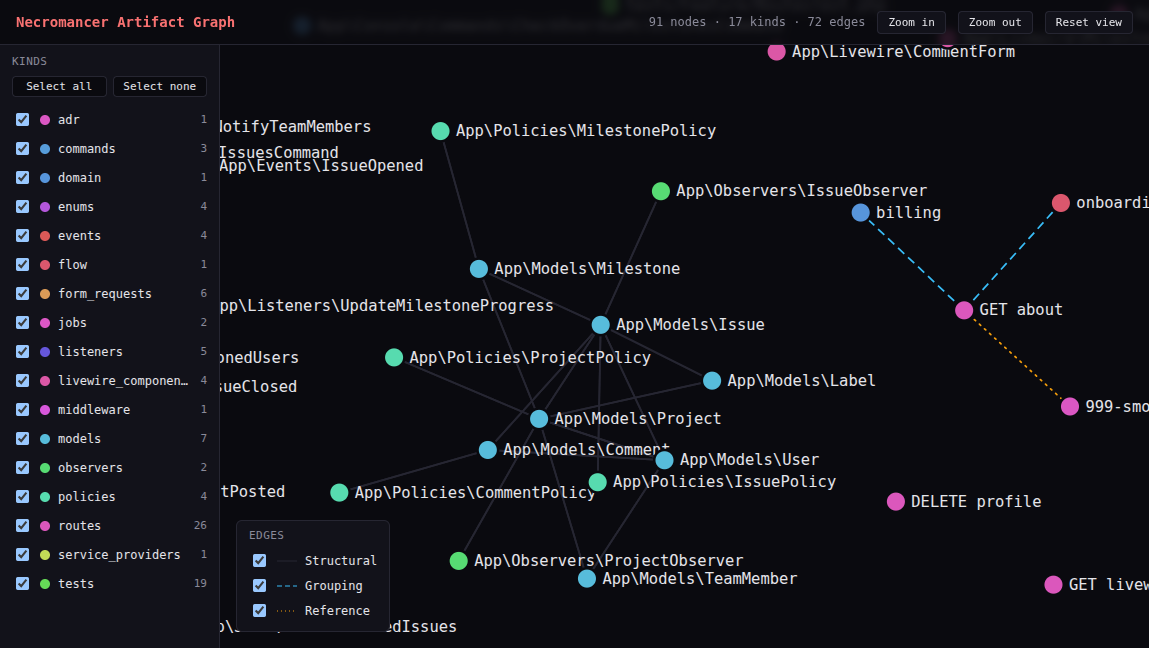
php artisan necromancer:graph
projects the manifest into an interactive, force-directed graph — colored by kind, connected by the same relationships your AI agent reads out of NECROMANCER.md. No build step, no server: graph.html opens straight from disk.
routesmodelsjobspoliciescommandsform_requests+ 12 more kinds, each colored the same way every time
Necromancer follows a scan-first workflow — every other command reads the manifest produced by
necromancer:scan. Grouped below by what you're trying to do, not execution order.
Bootstraps the application and writes the necromancer.json manifest. Re-run whenever your application changes. Supports partial scans and CI drift detection.
Terminal-based pretty-printer of the manifest inventory. Read-only; never writes to disk. Shows a stale-manifest warning if source files are newer than the manifest.
Scored AI-readability report (0–100). Findings grouped by severity: error (−10), warning (−5), suggestion (−1). Checks unnamed routes, missing model casts, dead events, unconfigured jobs, high-risk artifacts without an ADR, external-service artifacts without tests, and more.
Produces NECROMANCER.md — a full Markdown context file for AI coding agents. Renders Domain/Risk/External Services/ADR columns in the routes table when route metadata is declared. When Laravel Boost is installed, writes to .ai/guidelines/necromancer.md automatically. When a Knowledge Bundle exists (okf/ and/or okf-enriched/), a ## Knowledge Bundle section names its path, regenerate command, and live stats — unaffected by --only/--except/--paths, suppressible via okf.announce_in_context. Each line compares the bundle's own content_hash against the current manifest's and appends a "may be stale" caveat on mismatch — never a claim either way for a bundle exported before this field existed.
Builds a ready-to-paste AI prompt grounded in the most relevant manifest entries for your question. Keyword-searches the manifest, ranks artifacts by relevance, and outputs a prompt block with file:line citations.
Natural-language codebase Q&A. The manifest is injected verbatim into the AI's context — answers are grounded in your actual application, not the model's prior knowledge.
Generates Architecture Decision Records (ADRs) from the manifest. Evaluates nine architectural dimensions (async-processing, authorization, event-driven, api-design, data-modeling, command-scheduling, form-validation, external-services, architecture-pattern), with a critic agent reviewing and filtering the initial ADRs.
Compares the current manifest against a branch or snapshot. Shows added, removed, and modified routes, models, jobs, events, listeners, policies, and other artifacts. Added or changed artifacts of any family tagged high/critical risk or declaring external services surface in a dedicated "Flagged Artifacts" section — no AI required. With --review, an AI agent summarises the architectural impact and surfaces risks, grounded in the same flagged-artifacts signal.
php artisan necromancer:diff main
php artisan necromancer:diff main --review --format=markdown
php artisan necromancer:diff --base-manifest=snapshots/before.json
Measures how much Necromancer's generated context improves AI accuracy, hallucination rate, latency, and token cost. Runs a task suite in three conditions by default — no context, manual AGENTS.md, and Necromancer-generated NECROMANCER.md — and reports results side by side, including per-condition average latency (generation and, separately, judge). An opt-in fourth condition, necromancer-mcp (bare instructions plus live, tool-based manifest queries instead of a pre-assembled document), adds a "Necromancer (MCP) vs Necromancer (static)" comparison line when requested via --condition=. Use --generate-suite to scaffold a grounded task suite from the current manifest before running the benchmark.
Projects the manifest into a deterministic Open Knowledge Format (OKF) bundle — one Markdown file per artifact under okf/artifacts/, with authoritative YAML front matter and a concise Architectural Context prose mirror. Resolvable cross-artifact relationships (a route's controller, a model's relationships/policy/observers, event/listener pairings) render as Markdown links; every shared domain/flow value gets a synthesized, linked concept; and declared local ADRs are copied into the bundle with provenance — a missing one fails the export.
Writes an AI-enriched sibling bundle alongside the deterministic one — the okf/ bundle from necromancer:okf is never touched. Enrichment can only add a description field and an "AI-Enriched Summary" section — it structurally cannot change facts, annotations, Artifact IDs, or links, because the AI is never given access to those fields. Prompts exclude raw framework metadata, source paths/hashes, configuration, and ADR body content. Each concept caches independently, and a generated okf-enriched/README.md documents all of this, with bundle.json carrying its own content_hash.
necromancer:graph
--output=PATH--allow-stale--allow-partial
Projects the manifest into a deterministic Artifact Graph — see it pictured above. Structural edges mirror the OKF bundle's relationship taxonomy (route→controller, model→relationships/policy/observers, event→listeners); grouping edges connect an artifact to its declared domain/flow; reference edges connect it to a declared local ADR. The sidebar doubles as a color-coded legend and kind filter. graph.html is self-contained (no CDN dependencies) and opens straight from disk — no server needed. Entirely independent of necromancer:okf; refuses a stale or partial manifest by default; writes atomically.
php artisan necromancer:graph
php artisan necromancer:graph --allow-stale --allow-partial
php artisan necromancer:graph --output=dist/graph
open necromancer-graph/graph.html   # opens directly, no server needed
Add these steps to your pipeline to enforce manifest freshness and AI-readability quality gates.
- name:Check manifest is up to daterun: php artisan necromancer:scan --diff --fail-on-drift
- name:Fail on AI-readability errorsrun: php artisan necromancer:audit --fail-on=error
- name:Enforce minimum AI readability scorerun: php artisan necromancer:doctor --min-score=80
MCP Tools
When laravel/mcp is installed, Necromancer exposes the manifest as read-only tools via a
laravel-necromancer MCP server handle — auto-configured in .mcp.json on first run.
query_routes
List routes, optionally filtered by method or name/URI pattern.
query_models
List Eloquent models, optionally filtered by class name.
query_artifacts
List artifacts of any type, optionally filtered by JSON substring. Use when you know the artifact type.
search_artifacts
Full-text search across all artifact types. Use when you need to search across types.
Necromancer reads PHP 8 attributes as primary data sources alongside class properties. Codebases using the attribute-based API introduced in Laravel 11+ are fully supported.
annotations on every class-backed artifact, controllers (class default + action refinement), and middleware classes
Exact-ID mappings
config('necromancer.annotations')
annotations on closures, test files, gates, scheduled tasks, and registration-specific middleware — keyed by exact canonical Artifact ID, no wildcards
Route Metadata
On Laravel 13.17+, Necromancer reads route metadata set via the framework's native
Route::metadata()
API, under a reserved necromancer
namespace — a compact, declared-by-the-developer semantic signal that takes priority over anything
Necromancer infers from naming. Entirely opt-in: apps that don't set route metadata, or that run
an older Laravel version, are unaffected.
The withNecromancer()
route macro declares it with named arguments — every field optional, and dropped when left unset:
The macro is registered on every routing surface, so a group — or every route a resource registers —
can be tagged in one place. Routes inherit their group's fields, and a field declared on the route
itself wins for that field:
It is a shorthand, never a parallel metadata system — the fields go straight into native route
metadata under the configured namespace. The raw array form stays fully supported, and is what to
use on Laravel < 13.17, where the macro throws because the framework has no route metadata to
write to:
Artifact Annotation Coverage dimension: tagged with domain, high-risk artifacts with an ADR, external-service artifacts with tests, flow-consistent domain/risk — across every artifact family, not just routes.
necromancer:audit
Six checks: high-risk artifacts without an ADR, external-service artifacts without tests, narrative/overlong summaries, flows that disagree on domain or risk, non-canonical/near-duplicate identifiers, and missing local ADR files.
necromancer:generate & :ask
Conditional Domain/Risk/External Services/ADR table columns for routes, a compact Architectural Context column for every other artifact family, and a relevance boost for declared annotations when ranking evidence for a question.
necromancer:diff
A deterministic "Flagged Artifacts" section for any added/changed artifact of any family tagged high/critical risk or declaring external services — no AI required.
Privacy & Exclusions
— Never reads .env or raw configuration values
— Never collects or stores application secrets
— Horizon, Telescope, and Debugbar routes excluded by default
— Livewire's unnamed asset routes and Inertia's local DevTools routes excluded by default too
— Exclusions apply to every downstream command (map, audit, generate) — excluded artifacts never appear in results
2.0 removes the 1.x-only compatibility surfaces that eased the transition to universal Artifact Annotations
and Knowledge Bundles. Declaring annotations is unchanged — #[Necromancer],
withNecromancer(), and exact-ID config mappings all work as before.
What changes is what 2.0 stops reading, emitting, and accepting. Full details and a diff example are in the
README migration guide.
Manifests older than schema v1 are rejected, not upgraded
Every command that reads necromancer.json now treats a pre-1.5 manifest exactly like a missing one. Run php artisan necromancer:scan once after upgrading.
route_metadata.necromancer no longer appears in the manifest
Resolved annotations for every artifact family, routes included, live in the universal annotations key. route_metadata.raw — native Route::getMetadata() output — is unaffected.
--only=route-metadata-coverage no longer matches
Use the canonical --only=artifact-annotation-coverage dimension key on necromancer:doctor instead.
Two scan diagnostic codes were renamed
AN_LEGACY_VALUE/AN_LEGACY_RISK are now AN_SCHEMA_INCOMPATIBLE_VALUE/AN_SCHEMA_INCOMPATIBLE_RISK. The check is unchanged, only the name.
The singular adr parameter was removed
withNecromancer() and RouteMetadataFactory::forMetadata() only accept the plural adrs array now — swap adr: '...' for adrs: ['...'].